
Rowing Recruiting for Girls

Getting recruited to row in college comes down to three things: knowing what coaches measure, finding programs where you fit, and telling coaches about yourself clearly and early. This guide is for high school rowers, coxswains and parents who are new to the process and want a plain map of how it works.
Women's rowing has more college roster spots than almost any other women's sport, and many athletes who start rowing in high school go on to row in college. For a lot of young women, a college team becomes a place to grow stronger, more confident and part of something bigger than themselves. Coaches have limited time, though. The athletes who do well tend to be organized, honest about where they stand, and proactive. You have to drive your own recruiting, but you don't have to figure it out alone. That's what we do at Scout Performance Rowing.
How college rowing is set up
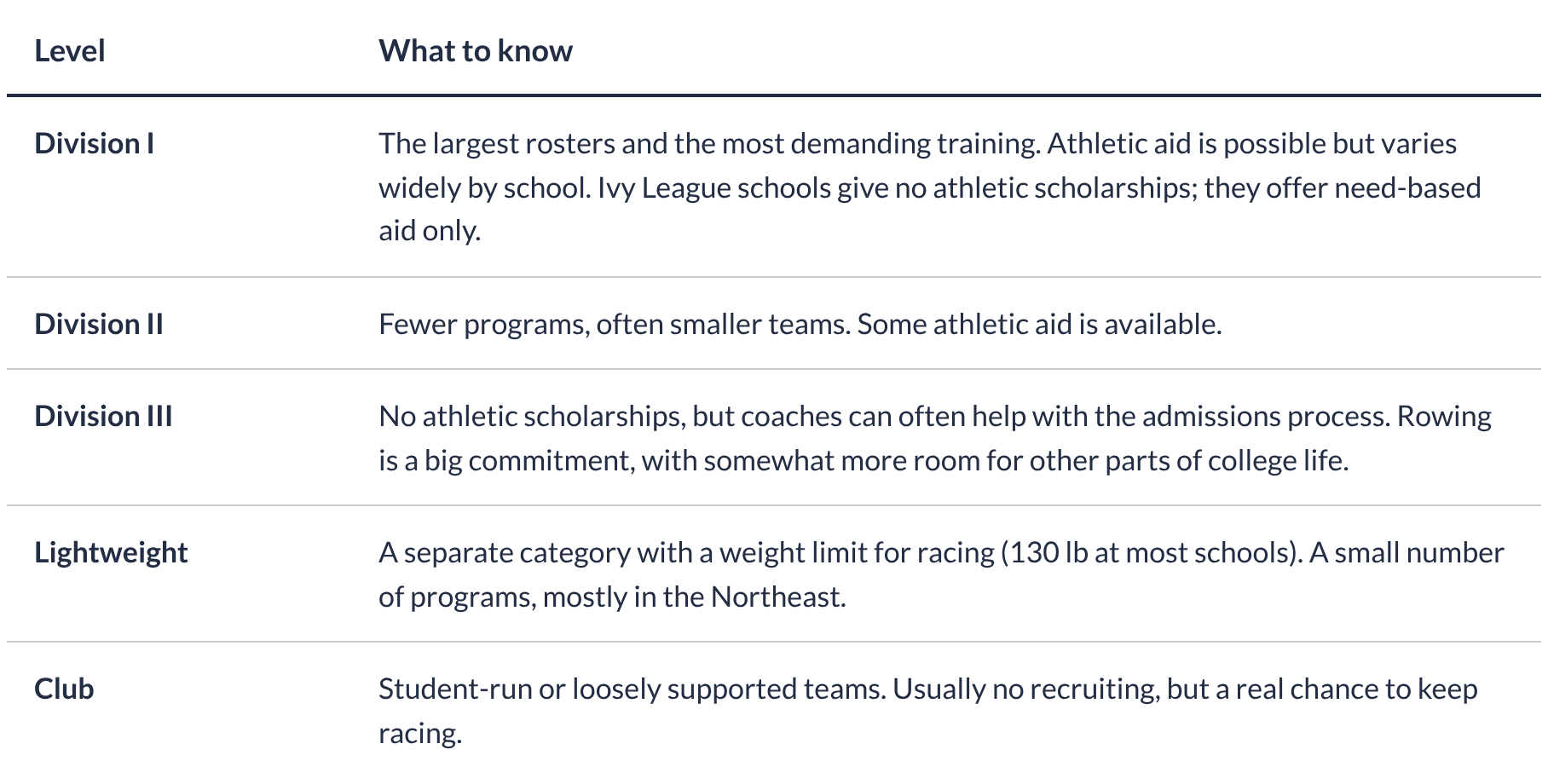
Women's rowing is an NCAA sport, with varsity programs in Division I, Division II and Division III. A handful of schools also run lightweight women's teams, and many more have club teams.
Scholarships and roster sizes are changing. Starting in 2025–26, Division I schools that opted into the House v. NCAA settlement may offer aid to every rower on the team, up to a roster limit of 68 for women's rowing (NCAA). In practice, few schools fund that many full scholarships. A hard cap also means fewer open spots for walk-ons at some programs. Always ask each coach how aid and roster spots work on their team.
Most college rowers don't get a full ride. Many get partial aid, admissions support, or no athletic money at all. Treat athletic aid as one piece of a bigger financial picture.
What coaches look for
Your 2k erg score is the first number most coaches look at, but it is never the only one. Coaches build a picture from several pieces:
• 2k erg time. It is the closest thing rowing has to a common yardstick. Coaches care about your best time and about how fast it is improving. A rower who drops 15 seconds in a year can be more appealing than one who has stalled.
• Height and weight. For openweight rowers, height and reach matter because longer levers move the boat farther per stroke. Coaches usually read your erg score alongside your size.
• Other erg tests. A 6k or 5k score shows aerobic fitness. Some coaches also ask for a 60-minute piece or a 30-minute test at a set stroke rate.
• On-water ability. Race results, video of your rowing, and your coach's opinion all tell a college coach whether your fitness turns into boat speed.
• Academics. Grades and course rigor matter at every level. At highly selective schools, coaches can only push for recruits who are strong enough to get admitted.
• Character and coachability. Coaches call your high school or club coach. They want to hear that you work hard, take feedback well and lift up the people around you.
Rough 2k ranges (approximate). Expectations differ a lot between programs and change from year to year. As a loose guide, top Division I openweight programs often recruit athletes in the 7:00–7:15 range or faster. Many Division I and strong Division III programs look at roughly 7:15–7:45. Plenty of programs take athletes slower than that, especially tall or fast-improving rowers. The best way to know where you stand is to ask each coach directly. And remember: your 2k measures your fitness today, not your potential or your worth.
Not sure how your numbers stack up, or how to drop time before the next test? Scout Performance Rowing's coaching pairs a training plan with an honest read on where your 2k puts you in recruiting.
Timeline, year by year
For most Division I recruits, the key date is June 15 after sophomore year. That is when coaches may start contacting you and talking about recruiting. Official and unofficial visits can begin August 1 before junior year (NCSA). Division II and III rules are more relaxed, and NCAA rules change often, so check the current version each year.
1. Freshman year: Learn to row well, build fitness and keep your grades strong. Start a simple log of your erg tests and race results.
2. Sophomore year: Begin researching schools. Fill out recruiting questionnaires on team websites. You can email coaches now; they can't write back with recruiting talk until June 15, but your name gets on their radar.
3. Summer before junior year: Contact opens. Send updated emails with your latest 2k and race results. Coaches will start calls and video chats with athletes who interest them.
4. Junior year: This is the busiest year for most Division I recruits. Take official and unofficial visits, test regularly, and keep coaches updated. Many top Division I recruits commit during this year or the summer after.
5. Senior year: Final visits and decisions for many Division I, Division II and Division III recruits. Apply to schools, including Early Decision where a coach has supported you. Keep training: coaches notice who stays committed.
If you're a late starter or a senior who just broke out, it's not too late. Many Division III and some Division I programs recruit well into senior year.
Build your recruiting profile
A one-page athletic resume lets a coach size you up in under a minute. Keep it current and send the same facts everywhere.
• Basics: Full name, graduation year, high school, club, city and state, email and phone.
• Measurements: Height, weight and wingspan, measured honestly.
• Erg scores: Best 2k with the date, plus a 6k or 5k. Say whether the time was verified (raced, or tested in front of a coach).
• Rowing experience: Years rowing, side (port, starboard or both), sculling vs. sweep, and the boats you've raced in.
• Results: Your biggest races with event, boat and finish.
• Academics: GPA, test scores if you're submitting them, and what you might want to study.
• References: Your current coach's name, email and phone.
• Video: A short clip (1–3 minutes) of you rowing, filmed from the side so a coach can see your whole stroke. Name which seat you're in.
Use a free spreadsheet, a simple web page or a recruiting platform like NCSA. A clean PDF attached to emails works fine.
Build your school list
Pick colleges where you'd thrive even if rowing ended tomorrow. Injuries, coaching changes and changing interests are common, so the school has to work without the team.
Start with 15–25 programs and sort them into three groups:
• Reach: Your numbers are a little below what the team usually recruits, or admission is a stretch.
• Target: Your erg, size and grades match recent recruits.
• Likely: You'd be a strong addition and admission looks very likely.
To judge your fit, compare yourself with current team members. Rosters on team websites often list height and hometown. Check recent race results to see how fast the team is. Then weigh the things that matter to you: academics, location, size, cost, team culture and how much each program trains.
Revise the list as your erg score and grades change. Most athletes' lists look very different by the end.
An outside opinion helps here. We help athletes build a balanced list based on their real numbers, so the reach schools stay reachable and the likely schools are places they'd actually want to go.
Contact coaches
The athlete, not the parent, should write to coaches. Coaches want to hear your voice and see that you're taking charge.
• Fill out the questionnaire first. Most team websites have a recruiting form. It puts you in the coach's database.
• Then send a personal email. Address the recruiting coordinator or the head coach by name. Keep it short.
• Make it specific. Say why that school appeals to you. Copying the same note to 30 coaches shows.
• Put your key numbers in the email body, not just in an attachment: grad year, height, 2k and GPA.
• Send updates. A short note after a new 2k PR, a big race or new grades keeps you on a coach's list.
• Be patient. Coaches get hundreds of emails, and Division I coaches can't reply with recruiting talk before June 15 after sophomore year. No reply isn't always a no. Follow up once after a few weeks.
Your first email is your first impression. Scout Performance Rowing reviews outreach emails, resumes and rowing video before they go out, so coaches see you at your best.
Visits, offers and committing
Visits. An unofficial visit is one you pay for yourself, and you can take as many as you like. On an official visit, the school pays some or all of your costs. Either way, try to watch a practice, meet the team without coaches around, sit in on a class and see where rowers live and train.
Questions worth asking coaches:
• Where do I fit on your team right now, and where could I be in two years?
• What does a typical training week look like in fall, winter and spring?
• How does athletic aid work here, and can it change from year to year?
• How do you support admissions for recruits, and what academic profile do I need?
• What happens if I get hurt or decide to stop rowing?
Offers. An offer can mean athletic aid, admissions support or a guaranteed roster spot. Get the details in writing and make sure you understand exactly what's promised. A verbal commitment isn't binding on either side until it's put in writing.
Committing. At scholarship schools, a commitment is usually made official with a written athletics aid agreement. Ivy League schools may issue a "likely letter" ahead of normal admission decisions. At many selective Division III schools, a coach supports your Early Decision application. Never commit just to end the stress. Be sure you'd choose this school even without the team.
Special cases
Coxswains. You won't be judged on an erg score. Coaches want race results, your weight, and recordings of your calls during races and practice. Include a short audio or video clip with your email, plus a reference from your coach about how you steer and lead.
Novices and late starters. Many college teams welcome athletes who are new to the sport, especially tall, athletic women from other sports. If you've rowed for less than a year, focus on your rate of improvement and your athletic background. There's room in this sport for you.
Parents. Your support matters most behind the scenes: keeping track of deadlines, budgeting for visits and talking through choices. Let your athlete lead conversations with coaches. Coaches want to recruit the athlete, not the family.
How Scout Performance Rowing can help
We believe every athlete deserves a recruiting process that builds her up, not one that wears her down. This guide covers the basics. Every athlete's path is different, and the details are what decide where you end up. Scout Performance Rowing combines recruiting guidance with performance coaching, so you get faster and get in front of the right coaches at the same time.
• Recruiting strategy: A personal plan and timeline built around your grad year, numbers and goals.
• School list building: A balanced list of programs where you'd fit athletically, academically and personally.
• Profile and outreach review: Feedback on your resume, video and coach emails before you hit send.
• Performance coaching: Training and erg testing support to raise the numbers coaches care about.
• Offer and decision support: Help comparing offers, preparing for visits and asking coaches the right questions.
Ready to get started? Book a consultation or email us at scoutperformancerowing@gmail.com
Recruiting can feel stressful, but it's also a chance to learn what you're capable of. Most athletes who stay organized and honest end up somewhere they're happy, surrounded by teammates who push them to be their best. Keep training, keep learning and enjoy the process. And when you want an expert in your corner, Scout Performance Rowing is here to help.